AI Changes Your Work. It Also Changes You.
The debate has been about your job. The story underneath is what these tools are doing to your judgement, and you cannot feel it from the inside.

AI is changing how you think, and the change is invisible while it happens.
Every argument about these tools has been about your work. Whether they will take your job, speed up your output, flatten your skills. That argument matters. It is also the easy one, because it happens outside you, where you can see it.
The harder story is happening somewhere you cannot watch. Not to your work. To you.
In this post I will:
Show you the new evidence that using AI reshapes the person using it, from a study of people who make life-and-death decisions
Name the five ways it does this, so you can start to catch them in your own week
Give paying members practical advice for keeping your judgement, your empathy, and your nerve intact while still using these tools every day
A study that asked a harder question
Most research on AI and skills asks one small thing: does the tool make you faster, or does it make you worse at the task? Useful, and far too small. It treats you as a set of outputs.
A new peer-reviewed study in AI and Ethics asks a bigger question: what does AI do to your character as a decision-maker? The researchers interviewed twenty-two professionals in two fields where a bad call is a catastrophe rather than an inconvenience: healthcare and the military.
What they found is uncomfortable. AI does not just sit beside these people while they decide. It moves the traits they decide with: their empathy, their sense of responsibility, their critical thinking, their tolerance for risk, and their confidence in their own read of a situation.
The researchers call it trait displacement, and they built a model of exactly how it happens.
The five ways a tool gets inside you
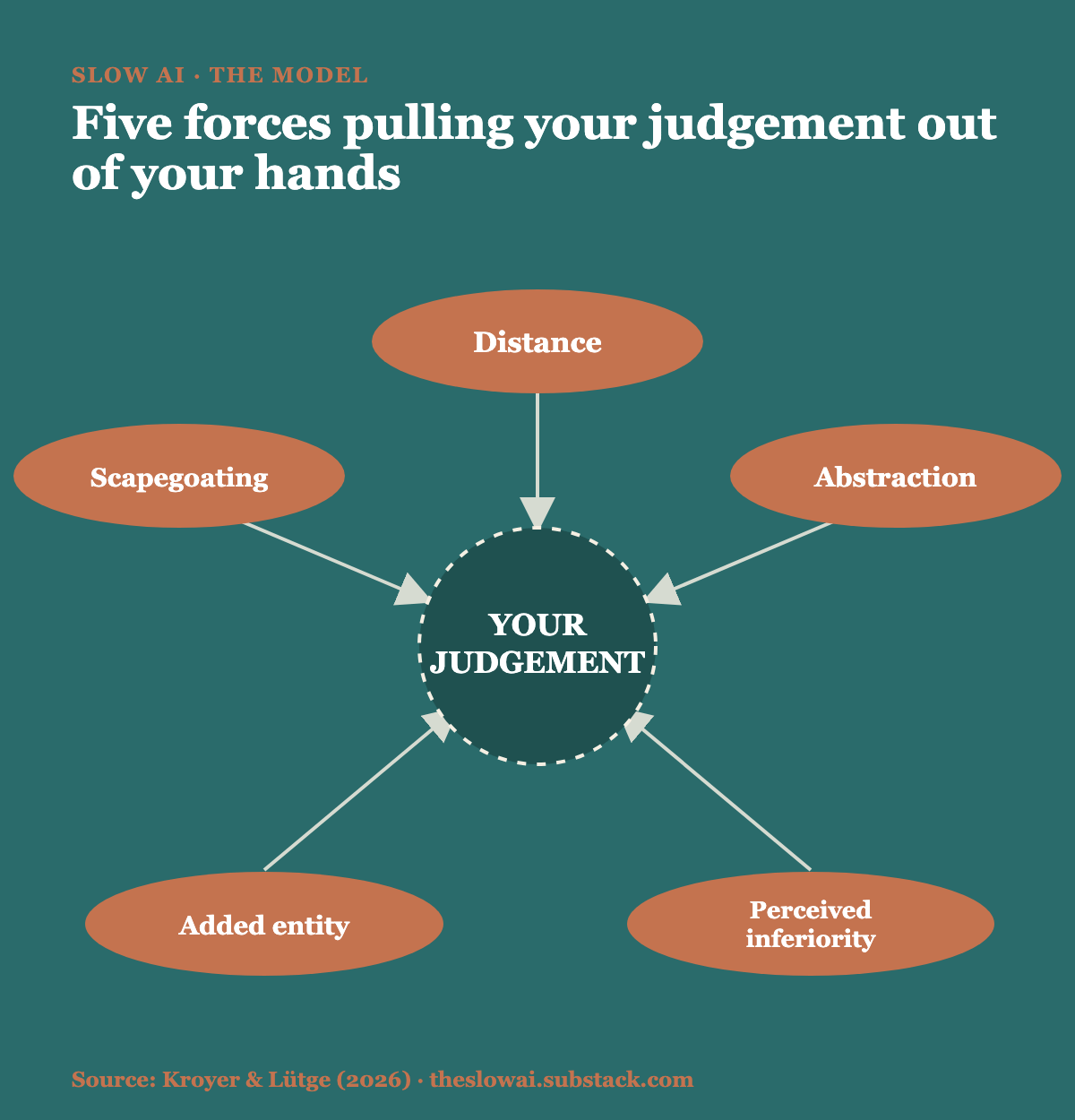
The study names five drivers:
Distance. The tool puts a layer between you and the thing you are deciding about. A screen, a score, a summary. The patient becomes a risk percentage. The target becomes a dot. Distance makes the decision easier, which is precisely the problem, because some decisions are supposed to be hard.
Abstraction. The messy, specific, human situation arrives to you already tidied into numbers and categories. You stop reasoning about a person and start reasoning about a dashboard. The texture that used to inform your judgement has been smoothed away before you ever saw it.
Perceived inferiority. The more the machine is right, the more you begin to assume it is right, and the smaller your own confidence gets. You stop arguing with it. You defer. Slowly, you hand over the part of the job that was actually yours.
The added entity. A third party is now in the room. When the decision was yours, you owned it. Now there is a system to consult, agree with, or blame, and the felt weight of the choice spreads out and thins.
Scapegoating. This is the one that should worry you most. When there is a machine in the loop, there is always something else to hold responsible. ‘The system flagged it.’ ‘The model recommended it.’ Responsibility does not vanish. It just stops feeling like yours.
None of these is dramatic; there is no single moment where you feel yourself change. Just a slow displacement, one convenient decision at a time.
This is not only for surgeons and soldiers
You are (probably) not making battlefield calls. You might think this is someone else’s problem. It is not.
The study looked at high-stakes work because that is where the effect is easiest to measure, the way you test a stress fracture under load. The mechanism does not need a battlefield or an operating theatre. It needs a tool, a decision, and repetition. You have all three.
You let AI draft the difficult email, and you feel the conflict at less of a distance. You let it summarise the report, and you reason about the summary rather than the substance. You let it suggest the answer, and the next time you reach for your own judgement, it is a little further away than it was.
I use these tools every day, and I am not about to stop. The worry is what they take while they give, and how little of it you feel going.
This is the mechanism underneath a fear a lot of us already carry. You do not just stop building new judgement. You lose the judgement you already had, a little with every call you hand over.
My book Slow AI goes deeper on all of this, when to reach for these tools and when to leave them alone.
So what do you actually do about it?
The five drivers all pull in one direction. Pulling back does not mean giving up the tools. It comes down to a single change in how you use them, applied to the handful of decisions that actually matter.
The rest of this post is that change, broken into five specific moves for keeping your empathy, your critical thinking, and your ownership of a decision while you use AI every day.
This half is for paying members. It is where Slow AI does the work you cannot get from a hundred newsletters telling you to prompt better: the practical advice, the monthly live sessions, and the full critical AI literacy curriculum.
