
Fable Fantasy
How a lifelong love of video games, an Amiga 500, and an AI called Fable turned into a lesson in critical AI literacy you can play.

I have just built two video games. I could not have written the code for either of them.
That is not because I never learned. In my twenties I wrote well over a million lines of code, through a PhD and a postdoc in atmospheric physics, as I have written about here before. But that was more than a decade ago, in languages built for satellites and climate models, and the skill has quietly faded. Use it or lose it is not a slogan. I used it, I stopped, and I lost it.
In this post I will:
Tell you why games matter to me, from an Amiga 500 to a save file my sister will never live down.
Show you two small games I made with AI, and how one of them teaches critical thinking by making you use it.
Make the case that this is what the humanities being the moat actually looks like, and ask for your help if you want to take it further.
This is the story of what let me build these games. It turns out to be a story about critical AI literacy, which is what I write about here every week, so stay with me. And if the words ‘built with AI’ already have you bristling, then please stay. I take the objection seriously and I get to it head on, later in this post.
The Rolls Royce in the playground
When I was six, my dad bought me an Amiga 500. Most of my friends had a Commodore 64. The Amiga was, by the standards of a school playground, a Rolls Royce, and I knew it. I have never forgotten the feeling of loading a game off a floppy disk and waiting, because the waiting was part of it.
The first game I remember is The Adventures of Maddog Williams in the Dungeons of Duridian, and you can play it for yourself here. What I remember is the world it opened, and the sense that a machine could hold a place you could walk around inside. That feeling has never really left me. One of the games I have just made, Just This Once, came straight out of it.
Aerith, and the save my sister wiped
Then came the PlayStation, and Final Fantasy VII, and Aerith. If you know, you know (sidenote but to me she will always be Aeris, perhaps my first experience of a machine-led fabrication). I put somewhere near a hundred and fifty hours into that game. I was on the cusp of the final crater, the very end, the part you build a hundred and fifty hours towards.
My sister, tidying up the memory card, overwrote my save with a level one Crash Bandicoot file.
I have made my peace with it, mostly. I tell it now the way you tell any story that hurt at the time and became precious later. That is the thing about games, and it is the reason I take them seriously. They are where a lot of us first learned to feel something real, about a character who was only ever pixels and a bit of music.
The thing I could no longer do
I have spent years designing games. Analogue ones, mostly. Card games and tabletop games and roleplaying games, some of which live on my site. I design them because a good game is one of the best teaching tools there is. You teach a system by letting someone play inside it and feel how it pushes back. A lecture rarely gets close.
The catch was always the same. I could design a digital game on paper all day long, and I could not build one. The code I once knew was for satellites and climate models, not games, and a decade of not using it had taken even that. Building a modern game meant relearning a whole craft from scratch, a wall I was never going to climb. So the games stayed on paper, or stayed in my head.
How AI changed that
This year I built the digital games I had been carrying around for a decade. I built them with AI, using Fable, and I want to be precise about what that means, because vagueness here is how people mislead each other about these tools.
I did not press a button and receive a game. I directed one. Every decision about what the game says, how it teaches, what it feels like to play, who the enemies are and why, came from me. The AI did the part I no longer could: it wrote the code, drew the pixels, and wired it all together, thousands of times faster than I could have relearned to. I brought the judgement, the story, the pedagogy, and the taste. It brought the execution.
That division is the argument of one of my book’s chapters, made real in front of me. The technical skill I had let fade has just been handed to far more people than ever had it before. What has not been handed out, and cannot be, is knowing what to build, why it matters, and when the thing you have made is any good. That is the humanities. That is the moat. This year I fell into the moat and found I could suddenly swim.
That argument, the humanities as the durable skill, has a whole chapter to itself in my book, Slow AI. If this post lands for you, the book goes further.
A game you win with questions
The bigger of the two games is called Consensus. It is a short 16-bit JRPG, and it is two things at once.
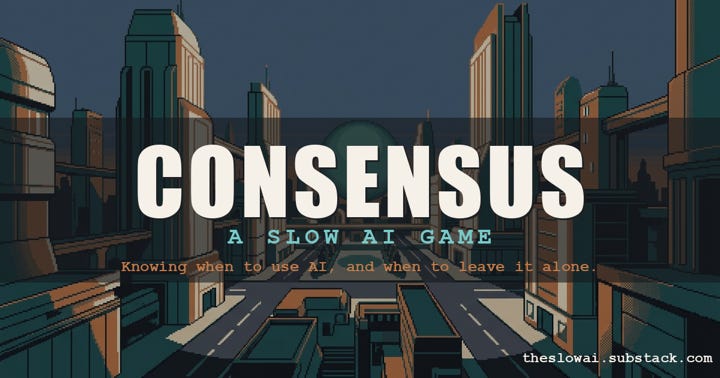
It is a demonstration. Every line, image, and rule of it was built end to end by AI, directed by one person who could not have coded it by hand. If you have ever wondered what these tools can actually do in the right hands, here is a whole playable answer.
It is also a tool, and this is the part I am proudest of. You play an Archivist in a city that handed every decision to an AI called the System and forgot how to choose. You go down to take the choosing back. When you meet the things that live down there, the Autopilot, the Doomscroll, the Yes-Man, hitting them barely dents them. You beat them by thinking. You check the source. You follow the money. You take a breath and slow down. The boss cannot be brute-forced at all. It only falls to good questions.
In other words, you win the game by doing critical AI literacy. You use it, under a bit of pressure, until it becomes a habit. That is how I have always believed this should be taught, and for the first time I could build the thing that teaches it.
The other game, Just This Once, is quieter. It is the one that came out of that felling of playing my Amiga as a young boy.
Both are free, and both play straight in your browser with no download and no account.
On AI in games
First, a distinction, because the phrase covers two very different things. When most people say they are against AI in games, they mean generative assets bolted into big commercial titles: art, voices, and writing produced by a machine and passed off as craft. What I have done is use AI to build the whole thing myself, as a person who otherwise could not. Those are not the same act, and I would not want them blurred.
On the first, there is a real debate, and I take it seriously. Look at how gamers rallied (or not) around Clair Obscur: Expedition 33, the debut from a roughly thirty-three-person studio that won game of the year at the 2025 Game Awards. Part of what people were celebrating was that a small team of humans made it. That hunger for the human-made is real, and I do not think anyone who feels it is wrong.
Here is where I land on the second, and it is only where I land. For someone like me, with the ideas and the pedagogy and no way to build, AI is a leveller. It turned a decade of paper designs into things you can actually play. It is an opportunity for play, for discovery, and, done with care, for learning critical AI literacy by doing it. That is my truth. As I often say, yours may be different.
Play it, and help me if you fancy it
So, two asks, no pressure on either.
Play them. Consensus takes about fifteen minutes. Just This Once is shorter. See whether a game can teach you something a post cannot.
And if you are a real developer, or an artist, or a games person, and you look at either of these and think there is something worth building properly, get in touch. These are demos. I would love to turn one of them into a proper game, and I cannot do the next part alone.
My friend Leor from Exploring ChatGPT, watching me disappear down this hole, said I should just call the whole thing Fable Fantasy. He was joking. I am not entirely sure he was wrong.
Go Slow.
Zork on the Commadore 64.
Space Invaders and Missile Command on Atari.
Dropping quarter after quarter after quarter into Donkey Kong Jr.
I can definitely relate to how these early problem solving challenges mapped to today. Getting around in Zork, finding things, making them useful, all using words, is, if not similar, certainly an echo.
Great perspective, great application.
I love video games and I will surely play these two (Consensus really interests me) but the element I want to focus on is "ai is a leveler". I completely agree. I work in an association, in a small french village, and we're trying to develop a local projet around STEAM knowledge for social innovation. I'm a designer and a nerd, with basic, basic coding capabilities. AI comes out, and a world unlocks for me. As an example, me, alone, I can now propose to care's local professionals to codevelop interactive aids for people with cognitive difficulties using inexpensive hardware. Before, even if I had the idea, I would had either had to spent 3 months learn a specific subset of coding, for then losing it two weeks after, or hiring someone (impossibile for a small organization with low budget).
My point is: AI is for sure still a strongly centralized, capital intensive commodity. But it can allow people with limited resources access to do great things. We should do it, we have to, this is the way it should be used, and we should demonstrate it and let it emerge, show the potential in small things beyond the slop making and automatic mail answering.