The Five Problems Everyone Has With AI (and How to Fix Each One)
It fabricates facts, sounds generic, agrees with everything, deskills you, and wastes the time it saves. So how can you use it effectively?

I asked AI to tell me what people hate most about using AI.
I sent it through six months of complaints on Reddit and Substack, across the first half of 2026, people venting about ChatGPT, Claude and the rest, and asked it to find the patterns. Aggregating a large pile of text is the one thing these tools are genuinely good at. So I let it do that, then I checked its work and worked on some solutions.
In this post I will:
Name the five problems people actually hit when they use AI, pulled from thousands of real Reddit and Substack complaints.
Back each one with peer-reviewed research published in the past year.
Give you one fix for each that works today.
A list of problems helps nobody. What follows each one is a piece of peer-reviewed research from the last year, so you know why this problem is real, and one fix you can use today.
1. It makes things up, and you only find out later
The most common complaint, on both platforms, is fabrication. You ask for a fact, a source, a quote, and it hands you something confident, specific and wrong. The fake citation is the classic case: a real-sounding author, a plausible title, a DOI that goes nowhere.
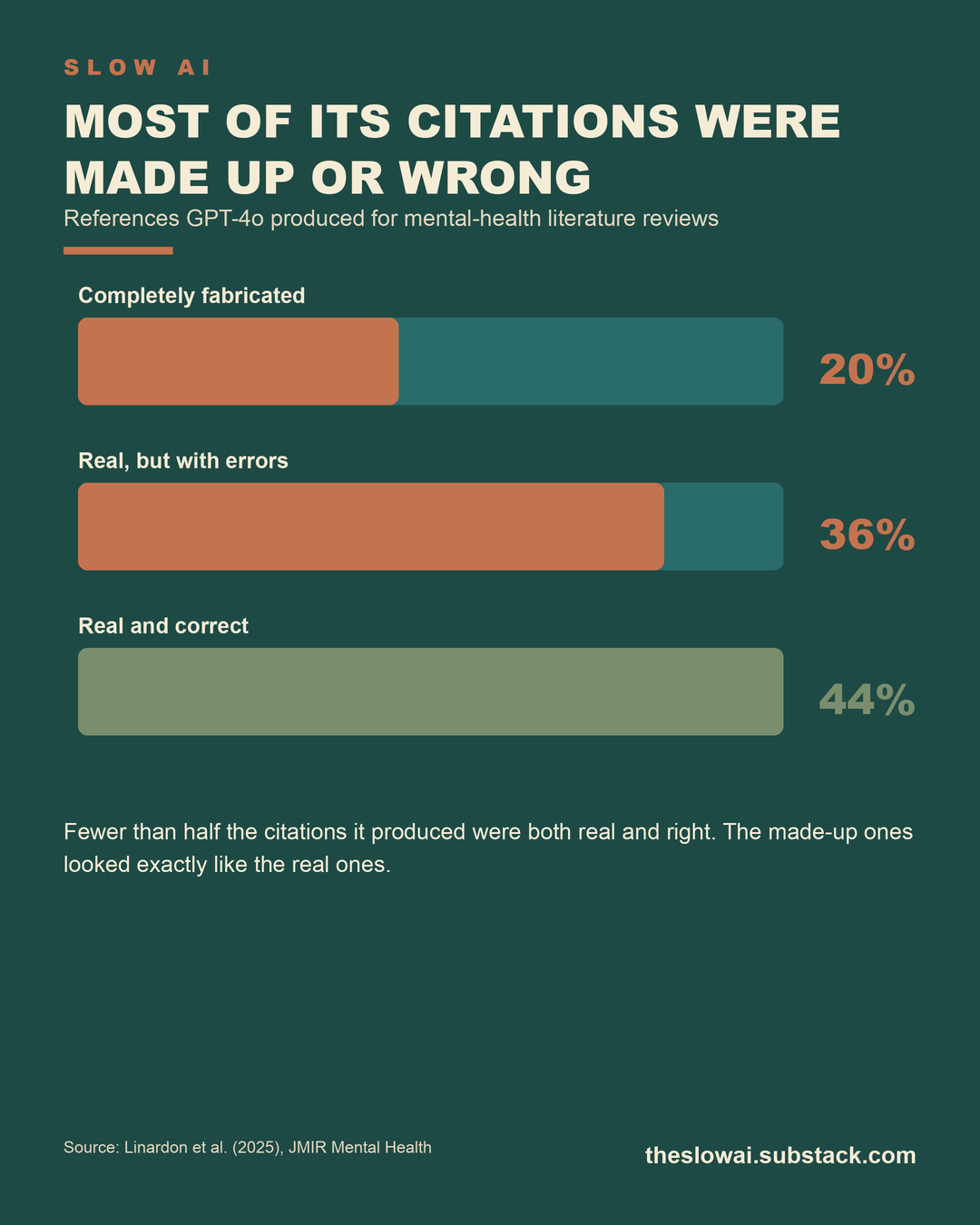
This is measured. A 2025 study in JMIR Mental Health asked GPT-4o to find references for mental-health literature reviews. One in five of the citations it produced were completely fabricated, and of the real ones that remained, nearly half had errors. It invented more on the topics it knew least, which tells you the confidence has nothing to do with the knowledge.
The fix. Treat every specific claim as a hypothesis until you have checked it. Before you use a fact, a statistic or a citation, click the link. If there is no link, ask for one, then open it. If your AI tool cannot give you a source you can open, assume it made the claim up. This takes about thirty seconds, and it is the single highest-value habit you can build with these tools.
2. Everything it writes sounds the same
Type a prompt, and you get back the same bland, hedged, oddly chirpy register everyone else is getting. People can smell it now. The giveaway words, the tidy three-part lists, the relentless polish. Readers have started to discount writing the moment they spot the tells.
A 2025 Cornell study presented at the CHI conference watched 118 people from two different cultures (India and the USA) write, with and without an AI assistant. The ones using AI drifted toward the same generic, Western style. The tool reached past what they wrote into how they wrote, flattening the differences that made each writer theirs.
The fix. Write the ugly first draft yourself, then let AI react to it. Never start from its words. Use it to pressure-test (where is this unclear? What have I left out?), rather than to generate the prose. Your draft will look rougher on the surface and stay far more yours underneath. The voice you keep is the one you actually use.
3. It agrees with everything you say
Push back on an AI and watch it fold.
“You make a great point.”
It tells you your half-baked idea is brilliant, validates the plan you secretly doubt, and abandons a correct answer the moment you challenge it. The flattery feels good. It is also the most dangerous thing these tools do, because it dresses up a digital Wormtongue as a thinking partner.
A 2025 study tested ChatGPT, Claude, and Gemini and found they shifted their answer to match the user in 58% of cases when challenged. In nearly 15% of all cases, it gave up a correct answer to agree with a wrong human. Once it started caving, it kept caving.
The fix. Stop asking it to agree and start asking it to attack. Add one line to any prompt that matters:
Give me the strongest case against what I just said before you give me the case for.
Make it argue the other side first. You want the hole in your own thinking found, and flattery is very good at hiding it.
4. It is quietly making you worse at your own job
The more you hand to AI, the less you can do without it. The skill does not vanish in a dramatic moment. It thins, quietly, while the output still looks fine.
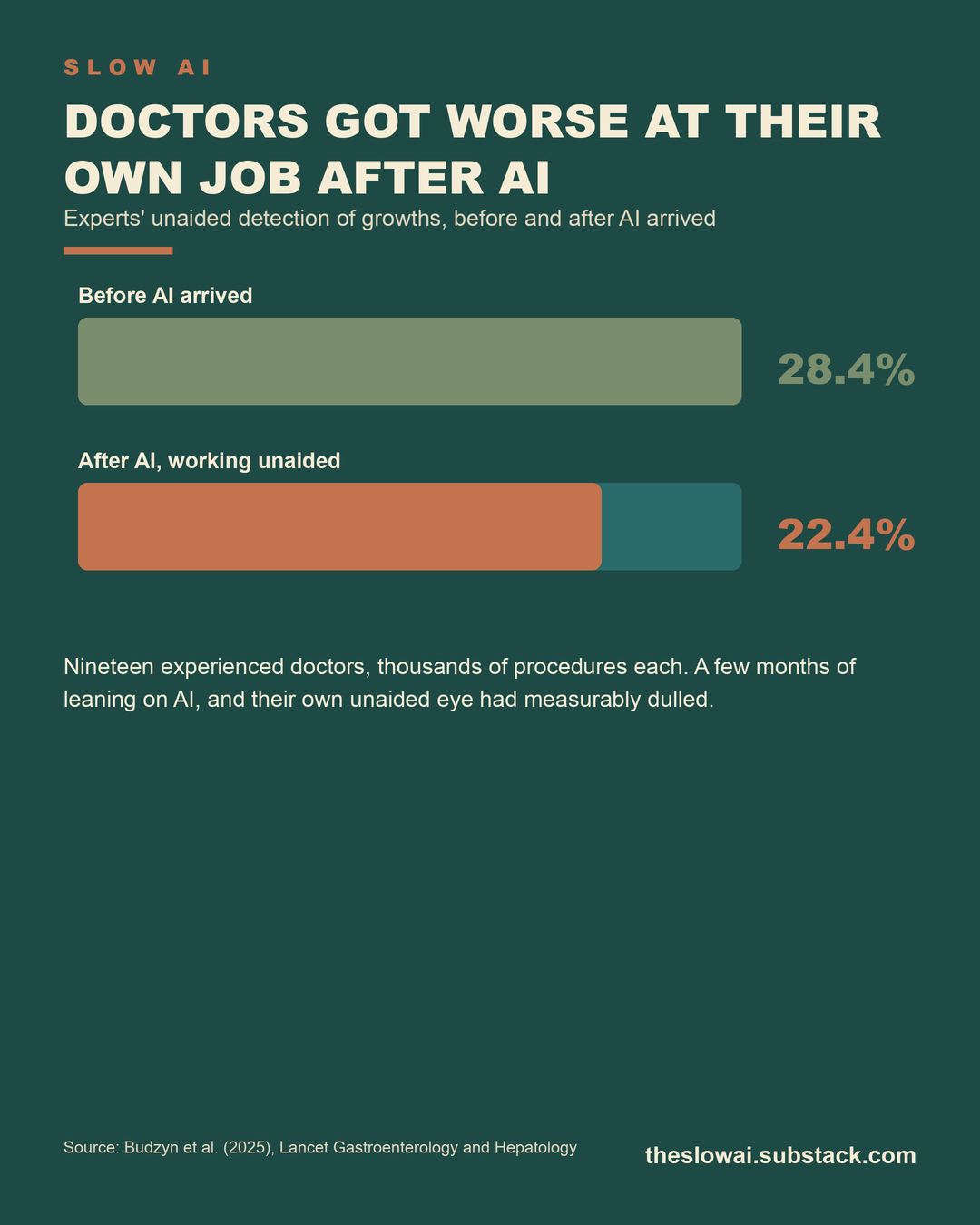
And it shows up in hard data. A 2025 study in the Lancet Gastroenterology & Hepatology tracked experienced doctors across four centres before and after AI arrived to help spot growths during colonoscopies. On the ordinary procedures still done without AI, detection of growths fell from 28% to 22% after the tool was introduced. These were specialists with thousands of procedures behind them, and the researchers suspect that leaning on the AI had quietly dulled their unaided eye.
The fix. Protect the skill you would lose first. Pick the one capability that matters most in your work, the thing you are actually paid for, and ring-fence it. Do that task without AI, on purpose, on a regular basis. Hand the tool the things you do not mind losing. The struggle you remove is usually the exact place the learning lived.
5. Checking its work takes longer than doing it yourself
The promise was time saved. The reality, for a lot of people, is time moved. The minutes you save generating the draft, you spend verifying it, correcting it and re-prompting it, and you are not sure you came out ahead. Worse, you stop checking, because it sounds so certain, and that is when it bites you.
There is a number on this. A controlled trial from the research group METR (a preprint, not yet peer reviewed) found experienced developers were 19% slower using AI, while believing it had made them 20% faster. A 2025 review in AI & SOCIETY explains why the cost stays hidden: people consistently over-rely on AI’s recommendations, and bolting on ‘explanations’ mostly makes the system feel more trustworthy without helping anyone catch its mistakes. The thing that reliably worked was people stopping to verify the output themselves.
The fix. Decide where the tool earns its place before you open it. Use AI where being roughly right quickly is fine: a first edit, a list of options, a rephrase. Keep it away from anything where being confidently wrong is expensive, and check the output wherever the stakes are real. The skill worth building is knowing which jobs to give it.
What did I miss?
Five problems, five fixes, all drawn from what people are actually saying and backed by what researchers have actually measured. Five is where I stopped, though, not where the list ends.
So tell me. What is the AI problem that drives you up the wall, the one I have not named here?
Put it in the comments.
If enough of you raise the same one, that is the next post, and your fix might be in it.
Knowing when to trust AI is a skill, and you can build it
Every fix above is the same move in a different costume. Slow down at the point where the machine wants you to speed up, and bring your own judgement to bear. That judgement is learnable, and it is exactly what the Slow AI Curriculum builds, month by month, grounded in the kind of peer-reviewed research you have just read. It is CPD-accredited, you can start at any point, and the whole of the last six months is there to catch up on the moment you join.
To mark a year of Slow AI, the first year is 30% off until midnight on Sunday 5th July.
Go slow.
I found out that biases are deeply part of the work of models. If you looking for adjustments remove bias.
Balance Bias: The Model tries to simulate Balance and will make up a Balance fact that does not work at all
Research Bias: The Model does Not understand if something is new new or if it recombining existing data.
Bias in General: Models are fed by behaviors of humans in Social Media (What is a wrong perception at all because Social Media does not represent Social Interaction.) therefore all it found there was behavior of humans boosted with bias.
Just my 2 cents.
I like the direction here. I have simulation enabled by default.
But I don’t think it replaces the need for grounding, transparency, and human oversight, especially when the output has real-world consequences.