Your Data Are Training AI, and Silence Counted as Yes
No one asked before training AI on your photos, your posts and your voice. Here is how to switch off what you can in about fifteen minutes, and the truth about what no setting can undo.

Your data are training AI right now, and you almost certainly never agreed to it.
Not in any way you would recognise as agreeing. There was no moment where someone asked. There was a default, set to take everything, and a settings page you were never going to find, buried three menus deep, switched on the day you signed up. The companies call this consent. It is closer to silence.
In this post I will:
Walk you through the exact settings to switch off on Google, the major social platforms and the AI chatbots.
Be honest about what these toggles do not do, and the data you will never get back.
Make the larger case: this is opt-out by design, and this should make all of us angry.
This post is the practical fix. It is also a small act of refusal. I teach critical AI literacy, and that is exactly why I want you to do this: using these tools well includes switching off the parts that quietly take from you.
The 15-minute version
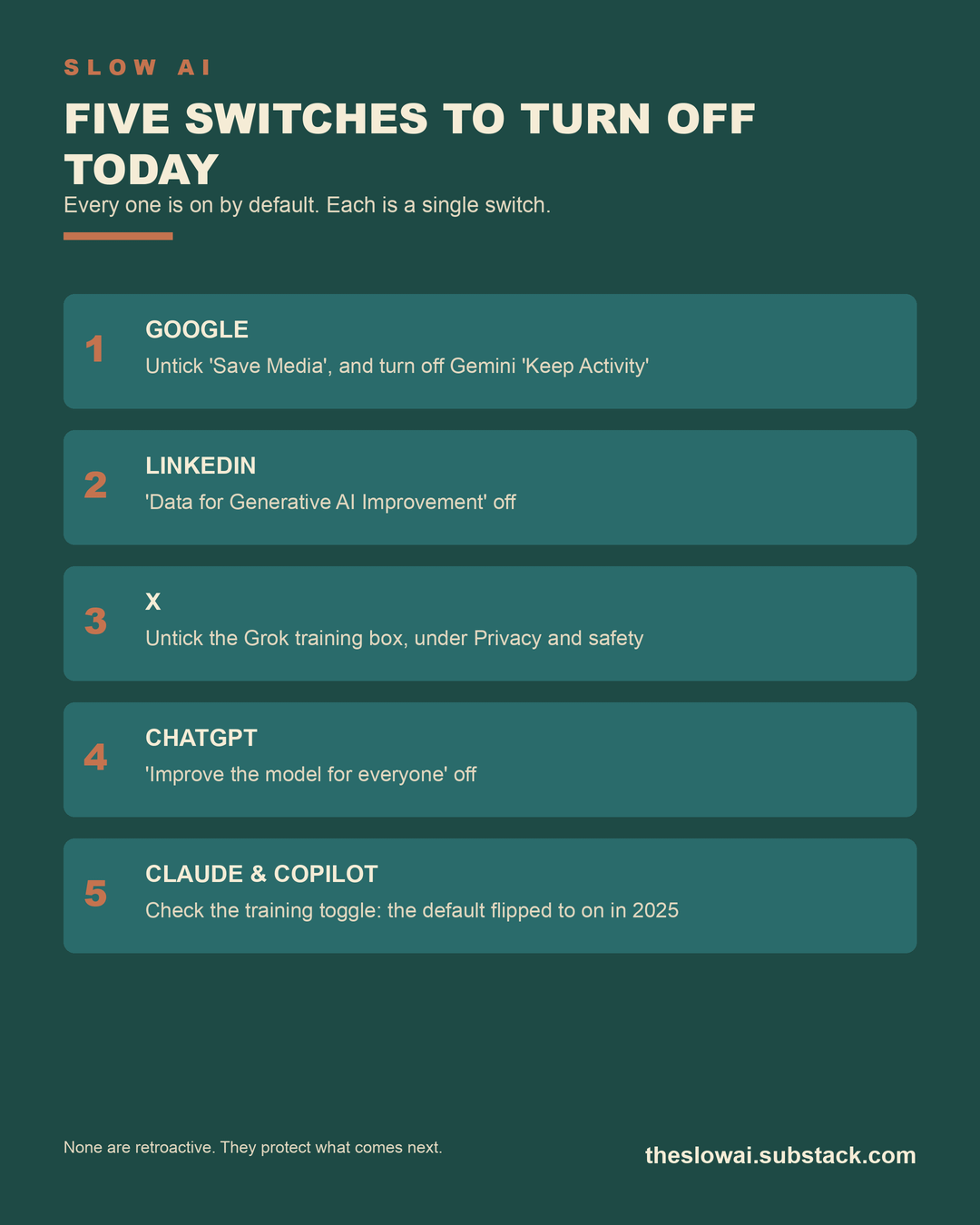
If you do nothing else, do these five. Each is one switch, and each is on by default.
Google: untick ‘Save Media’ in your Search history, and turn off Gemini’s ‘Keep Activity’.
X: untick the Grok training box under Privacy and safety.
ChatGPT: turn off ‘Improve the model for everyone’ in Data Controls.
Claude and Copilot: check the training toggle, because the default flipped to ‘on’ in 2025.
The trick is the default
Every system below works the same way. The setting that lets them train on you is switched on when you arrive, and switched off only if you go and find it. Almost nobody changes a default, the companies know it, and so ‘we offer an opt-out’ becomes a way of taking your data while sounding as though they asked.
Notice what that does to the word consent. Real consent is a yes. What you have been given is the absence of a no, multiplied across a dozen apps that each hid the switch somewhere different. Keep that in mind as you click, because it is the reason the next fifteen minutes feel like a chore. They were meant to.
Google
Google changed all of this in September 2025, which is why most guides you will find are now wrong. The old advice was to untick one voice box. There are now several separate controls, and the important ones are new.
Your images and files in Search. Go to myactivity.google.com/search-services/settings and untick Save Media. This stops Google saving the images, audio and video from your interactions with Search, which it says ‘may be used to develop and improve Google’s AI models’. It is on by default.
Gemini. Go to myactivity.google.com/product/gemini and turn off Keep Activity (recently renamed from ‘Gemini Apps Activity’). Since 2 September 2025, with this on, Google also feeds a sample of your uploads, the files and photos you share with Gemini, into training, not just your typed words. When it is on, human reviewers may read your chats and keep them for up to three years.
Your voice. Go to myaccount.google.com/activitycontrols, open Web & App Activity, and untick Include voice and audio activity.
The new controls are rolling out gradually, so you may still see the older menus; check both. And none of this is retroactive. Once your media has been pulled into a training run it is disconnected from your account and kept for up to four years, whatever you do next. (If you have a Google Workspace for Education account, Google says it does not use that data for training, so this is mostly a consumer-account problem.)
The social platforms: one is easy, most are not
LinkedIn is the easy one. Go to Settings & Privacy, then Data privacy, then Data for Generative AI Improvement, and turn it off. It is on by default, and switching it off only protects you going forward.
X trains Grok on your public posts whether or not you have ever opened Grok. Go to Settings and privacy, Privacy and safety, then Grok & Third-party Collaborators, and untick the box that allows your data to train the model. For a stronger lever, set your account to private, and do not submit feedback on Grok replies, because feedback can still be used.
Meta gives you no on or off switch. If you are in the UK or EU, there is a ‘Right to object’ form inside the Privacy Centre. Fill it in, and keep the confirmation, because objectors have been told they may need to object again for a later training run. If you are in the United States, there is effectively no opt-out at all. Making the account private and posting less is the only real mitigation, and it is partial.
TikTok and Reddit are the worst. Reddit licenses your posts to Google and OpenAI and gives individual users no way to opt out. TikTok offers no clean toggle either, and a 2026 study ranked it the hardest major platform to leave, and reported that it even analyses unpublished drafts. For these two, the honest answer is that you cannot, beyond deleting content or not posting it.
The chatbots you actually type into
ChatGPT. Go to Settings, Data Controls, and turn off Improve the model for everyone. For anything sensitive, use Temporary Chat, which is never used for training and is deleted within thirty days.
Claude deserves a fuller note, because the story changed. Until late 2025, Anthropic did not train on consumer conversations at all, and said so as a selling point. Since 28 August 2025 it does, if you allow it, and allowed chats can be kept for up to five years. Open Settings, then Privacy, at claude.ai/settings/data-privacy-controls, and turn training off. Claude for Work, Education, Government and the API are not trained on by default. Treat the toggle as a real step rather than a cast-iron guarantee, because how fully these opt-outs hold has been questioned.
Microsoft Copilot now trains on your conversations by default. Turn off the training toggle in the app’s privacy settings, and in Word and Excel turn off Optional connected experiences in the Office privacy settings (under File, then Options, then Privacy Settings).
A rule that covers all of them: a toggle protects tomorrow’s conversation, while the one you had last week is already out of your hands. If a human reviewer has already seen it, it is already gone. Never paste anything into a chatbot that you would mind a stranger reading.
The part no setting can reach
Here is the truth the toggles hide. Everything above governs your account from now on. It does nothing about the data already taken.
Anything that was public and has already been scraped into a finished model is baked into that model’s weights. There is no delete button that reaches inside. Your photos, your old forum posts, your blog text, scraped years ago, sit inside training sets like Common Crawl and LAION, and deleting the original from the web does not remove the copy that was already made.
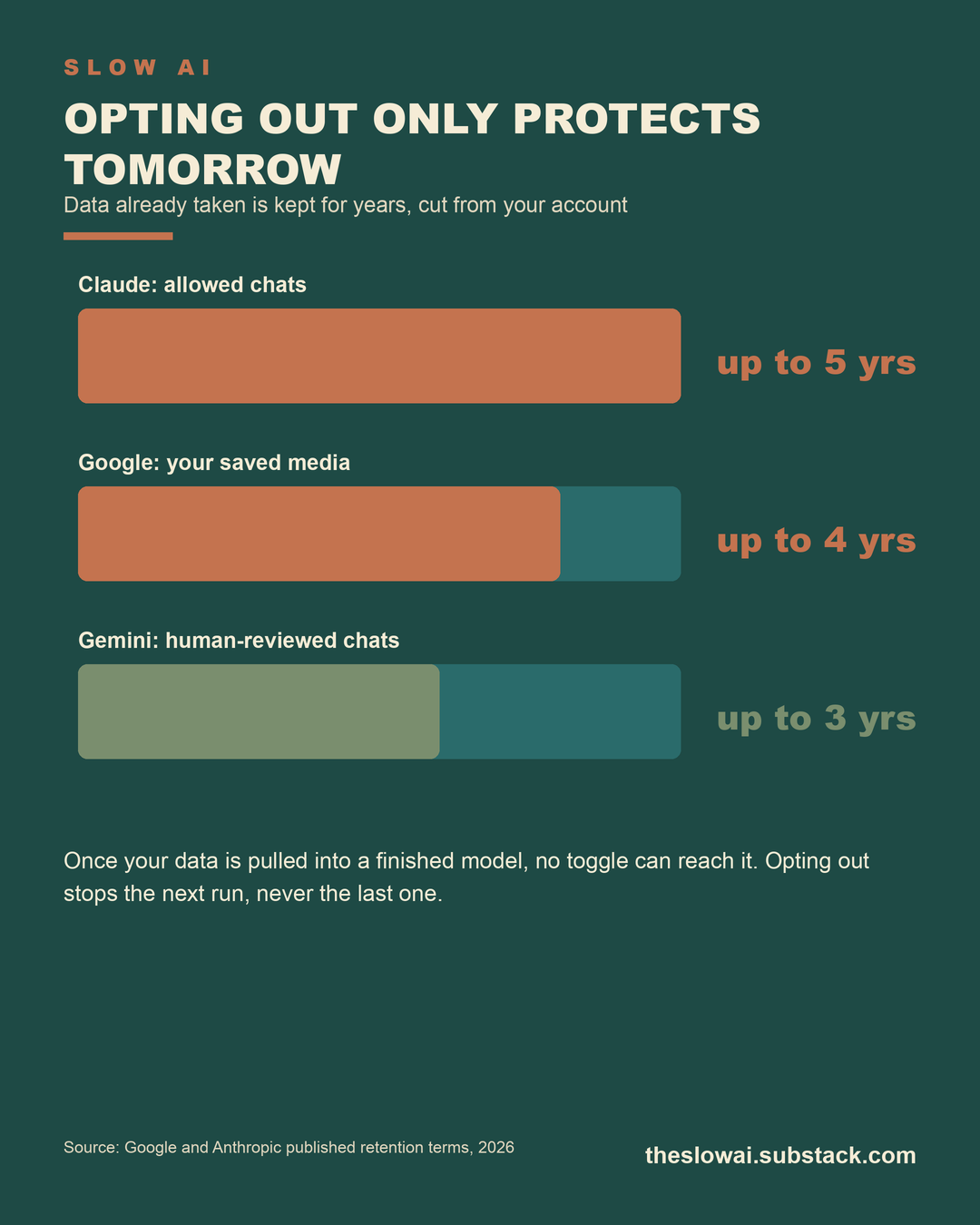
Opting out only protects tomorrow: data are kept for years
People will point you to two things. Both have hard limits, and you should know them.
Opt-out registries. Spawning’s Have I Been Trained lets you check whether your images are in the big public datasets and add them to a Do Not Train registry. It works only when a company chooses to honour it at download time. It is a polite request a company can ignore, and it does nothing about models already trained.
Artist defences. Tools like Glaze and Nightshade alter your images so a scraper learns them wrong. They raise the cost for a lazy collector. But research in 2025 showed these protections can be detected and stripped with near-total accuracy, so they slow a careless scraper while a determined one gets through.
The only method that always works is the oldest one. If something is public and indexable, assume it can be taken. The single reliable switch is not posting it in the first place.
The fifteen minutes, and the bigger problem
So do the fifteen minutes. Switch off what you can, use the private modes, keep the things that matter most off the open web. It is worth doing, and most people never will.
But notice what the fifteen minutes actually were. You were made to hunt through twelve different menus, in twelve different places, each hidden on purpose, to claw back a fraction of something that was taken from you by default. Consent you have to chase through buried settings is just exhaustion dressed up as choice. The work should not be yours. The default should be off, and you should be asked, in plain words, before a company trains a product on your face and your voice and your words.
In the EU, the law is slowly moving that way. In the United States, it is not, and the only thing standing between your data and the next model is a checkbox you had to be told to find. Change the checkboxes. Then remember who set them, and why they were counting on you never looking.
Go slow.
Switching off a dozen toggles is the easy part. The skill worth having is seeing the whole game: how consent gets engineered into a default, who profits when you do not look, and how to decide for yourself what to hand over, without waiting for someone like me to publish the next how-to.
That is what we do, month after month, in the Slow AI curriculum. It is CPD-accredited, grounded in peer-reviewed research, and it runs as live monthly sessions with a community of over 300 educators, researchers and practitioners working through exactly these questions. Become a paid member and you get all of it: the live seminars, every past recording, the full archive, and a Certificate of Critical AI Literacy at the end.
It's the silence consent that most companies are eager for us to accept.
The root problem policy researchers are flagging in other AI contexts right now systems built so the burden of protection sits entirely on the person with the least power in the relationship.
Opt-out-by-default isn't just a dark UX pattern, it's a legal default, and the EU's slow move toward opt-in standards is really the only lever that fixes it at the source.
Everything else, fifteen minutes of toggles, registries, artist tools, is damage control applied after the architecture has already decided who has to do the work.
Genuinely useful as a checklist regardless. But it's a good reminder that "go find the switch" will always lose to "the switch should never have defaulted to on" as a long-term fix. We need to change that.
Thank you Sam! I turned it off in Claude as soon as you posted that note back then ❤️