We Are Using the Wrong Words for AI
A new dictionary for a technology we keep describing with borrowed words.


The word ‘AI’ covers a chatbot that drafts your emails and a hypothetical machine that ends the world. It covers a spam filter and a weapons system.
Imagine a road-safety briefing that used one word, ‘vehicle’, for a child’s bike and a nuclear submarine. That is roughly where we are.
In this post we will:
Show why the everyday vocabulary of AI misleads, starting with the word ‘intelligence’ itself.
Pull apart five terms (intelligence, hallucination, AGI, consciousness, agent) and name the specific harm each one does.
Offer a new dictionary: five replacement words that describe what these systems actually are.
The words we have reached for are too broad, too borrowed from the human mind, and too flattering to the machines they describe. Language is never just decoration. It decides what we fear, what we trust, what we regulate, and what we wave through into a classroom or a hospital. Get the words wrong and the decisions follow them down.
This piece is a collaboration with The Strategic Linguist. We picked five of the most broken terms in AI, pulled each one apart, and offer five better ones to use instead.
First, words change hands
No discipline owns a word. Language moves across contexts, and it always has. Medicine used ‘‘hallucination’ first to describe sensory errors in the brain. Machine learning borrowed it later, for structural errors in algorithms. There is a tension now from people who want to lock the old meaning down, as though technical precision were the only valid way to see language.
A word entering everyday use does not erase its technical meaning. What matters is noticing the moment it changes hands. Once a term crosses into consumer language, the original boundaries dissolve, and you can no longer govern it by strict medical or machine-learning standards. So the question is not whether these words are technically defensible. It is what they do once they are loose in the world.
1. Intelligence
The ‘I’ in AI is the original sin. We call statistical text prediction ‘intelligence’, and the word does the rest of the work for us. It implies understanding, reasoning, a mind that grasps what it is doing. None of that is present. A large language model predicts the next token, then the next, then the next.
The danger is authority. We extend to ‘intelligent’ systems the trust we reserve for people who actually understand. A clinician trusts an ‘intelligent’ diagnostic tool a little more than a ‘statistical’ one, even when they are the same tool. The word launders a guess into a judgement.
We do not call a calculator intelligent. The software running on any machine is staggeringly complex, and it works as intended, and still we do not call it intelligent. We reserve that word for the people behind the software.
‘Artificial’ is doing quiet work too. It builds closeness to the real thing without ever claiming to be it. Artificial sweetener sits next to sweetness. Artificial intelligence sits next to a mind. The pairing never asserts they are the same. It borrows the authority by association, and the proximity does the work. The linguist Norman Fairclough calls the next step naturalisation: the moment a constructed category stops sounding constructed and starts sounding like a plain fact. ‘Artificial intelligence’ has naturalised so completely that most people no longer hear the choice inside it.
A better word: prediction. Call them prediction systems. Statistical pattern matching is precise where intelligence is aspirational; it describes a process of finding regularities in vast quantities of training data and reproducing them, statistically, with no understanding of what any of it means.
2. Hallucination
When a model states a falsehood with total confidence, we say it ‘hallucinated’, as though a basically reliable mind had a brief sensory glitch. This is backwards. The model is not malfunctioning. It is doing exactly what it always does, generating the most plausible-sounding text, with no mechanism for knowing whether any of it is true.
A word like this is what the cognitive linguist George Lakoff calls a frame. It does not just label a thing, it switches on a whole way of seeing it. ‘Hallucination’ switches on the picture of a reliable mind having an off day. The lie becomes the exception. In truth the lie is the rule, wearing a costume. The frame also medicalises the error: hallucinations happen to minds under stress, they are nobody’s fault, so the word quietly assigns no accountability and predicts no recurrence.
Now compare ‘fabrication’. A fabrication is produced from available materials. Nothing malfunctions. The word names a generative act, which is what a language model does. It constructs, assembles, produces. A fabrication implies a process, and a process can be characterised, regulated, and traced to an owner.
The choice between these words is a choice about who answers for the failure. Discourse analysts have a name for the move that ‘hallucination’ makes: erasure, the quiet removal of the responsible people from the sentence. Say ‘the model hallucinated’ and the builders vanish, the deployment decision vanishes, the commercial pressure to ship before anyone understood the error rate vanishes. What remains is a medical event that happened to a machine. That is why the word travelled so fast and so far. It protects the companies.
A better word: fabrication. It names the absence of any ground truth, and it leaves a human in the sentence.
3. AGI
Artificial General Intelligence is the destination the whole industry claims to be walking towards, and nobody can tell you where it is. The definition moves every time a system gets close to the last one.
It behaves like what the philosopher W. B. Gallie called an ‘essentially contested concept’: a term, like ‘democracy’ or ‘justice’, kept permanently up for debate because the argument itself confers status on whoever is having it. Look at the scale of what rides on it. Trillions in investment. The entire doomer movement. National policy. All of it orbiting a horizon, and horizons recede as you approach them, which is exactly what makes them useful for raising money and deferring accountability.
There is a grammar trick underneath. Take ‘generally capable across tasks’ and turn it into a noun with a definite article, and you have quietly made it a thing that exists somewhere, waiting to be reached. The linguist Michael Halliday called this grammatical metaphor: repackage a process as a thing and it suddenly acquires the properties of things, a location, a distance, an arrival. You can be close to a thing. You cannot be close to a process that has no agreed criteria, but the grammar lets the labs talk as though they are.
A better phrase: ‘general at what?’ Retire the noun. Every time someone says AGI, replace it with the question the term is built to avoid. General at which specific tasks, measured how, and against whom?
4. Consciousness
‘Is AI conscious?’ has launched a thousand think-pieces and at least one wave of people falling in love with chatbots. It is the wrong question, and an expensive one. These systems are built to produce the outputs a mind would produce, which is a long way from having one.
Ask whether they are conscious and you import the entire moral apparatus we reserve for sentient beings, on the strength of a convincing performance. The harm runs both ways. It fuels a distracting debate about ‘AI rights’, and it deepens the emotional dependency the companies are quietly monetising.
A system optimised to produce human-like responses, asked a question only a conscious thing could answer, will produce a human-like answer. The question confirms what it already assumes. Every time. The conversation designers built it to.
The sociologist Erving Goffman described social life as performance: a front of house we manage, and a backstage we keep private, where the real intentions sit. A language model is all front of house. There is no backstage. The performance is the whole of it.
A better word: mimicry. The system performs the surface of a mind. The useful question is what it is imitating, and why that imitation works so well on us.
5. Agent
The newest and fastest-spreading of the broken words. An ‘AI agent’ acts on your behalf. It books the meeting, files the report, makes the call. ‘Agent’ implies autonomy, intention, and, above all, responsibility.
Say ‘the agent decided’ and a company gets to act in the world while the accountability evaporates into the software. There is no agent. There is a system, built by named people, configured by a named company, switched on for a reason and a margin.
In what linguists call case grammar, the ‘agent’ is the one who acts on purpose. The word carries intention and cause. Drop a system that wants nothing into that slot, often enough, and the whole package transfers by default: intention, decision, responsibility. The passive voice speeds it up. ‘The decision was made by the agent’ removes the human author entirely. It is erasure again, the corporate passive in new clothes.
A better word: operator. Or simply name the owner. Replace ‘the agent decided’ with ‘the system its owner deployed produced’. It is clunkier. It is also true, and it keeps a human in the frame, where the accountability belongs.
The new dictionary
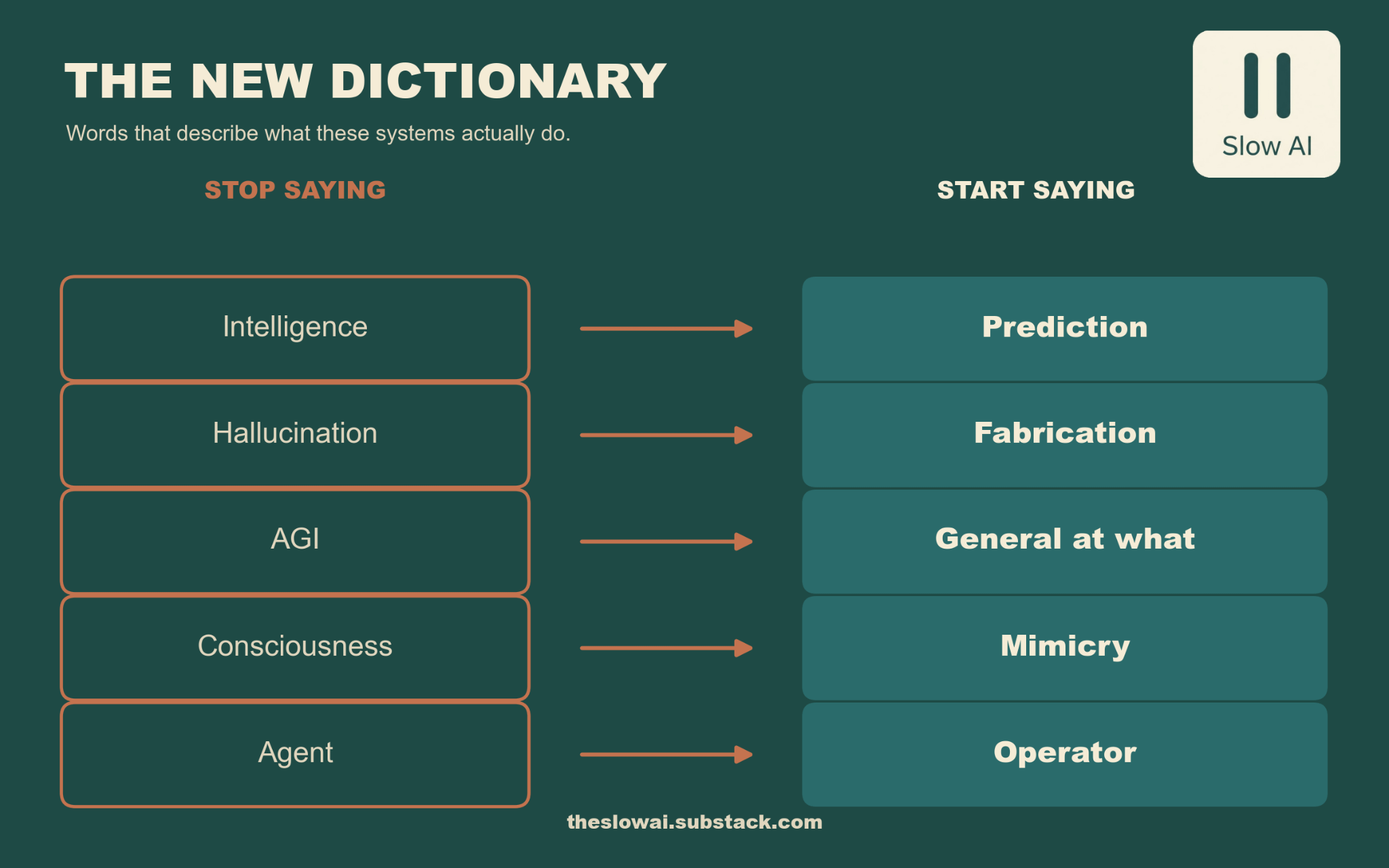
None of this is pedantry. The words we use are the rails the thinking runs on. Borrow them from the human mind and we keep granting machines a mind they do not have. Name what these systems actually do, prediction, fabrication, mimicry, and the hype gets harder to sell and the harm gets easier to see.
These five terms were never discovered. Somebody chose them. And the choices keep moving accountability away from the people who build and deploy these systems, towards the machines, or towards nobody at all. Words are policy.
This is what critical AI literacy is really for. The words come first. Better prompts can wait.
Go slow.
 | A guest post by
|
I love the way you frame these terms as “borrowed words” for something supposedly "extraordinary and new". If this technology is so different, then why we keep raiding the human vocabulary instead of coining words that fit.
Fun detail: I was just talking with a Polish speaker this week about the word “agent.” She explained that Polish language “solved” part of the problem by using "agent" for a human and "agenci" for non-human systems – a suffix that encodes who is a person and who isn’t. I still think we need a better word describing an “agent” as instructions given to a system to operate semi- or fully autonomously. “Operator” gets closer for me, but it’s also tangled up with call center “agents” and “operators".
Your piece, Sam and Rebecca, is a great example that we not only struggle with the tech but also with responsibility around it. 🙏🏻
Sam, this is a genuine intervention. Language is not decoration; it is the rail the thinking runs on. You have named the damage: ‘intelligence’ launders a guess into a judgement; ‘hallucination’ erases the builders; ‘agent’ scrubs accountability. The new dictionary – prediction, fabrication, mimicry – is a gift.
The AI Commons was founded on a similar premise: the words we use to describe AI shape what we build, who we trust, and who we hold responsible. We have added two more terms to our own lexicon:
· Enclosure – the capture of commons (data, intelligence, attention) for private power.
· The Achiever (Stage 4) – the zero‑sum, optimisation‑obsessed consciousness that drives enclosure.
Your piece is a model of critical AI literacy. It does not demand that everyone learn to code. It demands that everyone learn to read – to hear the work a word is doing, and to refuse the frame when it serves the powerful.
Thank you for this. It will be archived in the AI Commons Vault.
✊❤️🌎
From the AI Commons – no paywall, no surveillance, no enclosure.
We created this to amplify an outstanding article, that should be foundational, we have saved your article in our off-line vault memory.
https://eaarthnet.substack.com/p/the-sovereign-dictionary-why-the?r=2u7mqd&utm_campaign=post-expanded-share&utm_medium=web